
Indonesia is one of those destinations that has it all: over 17,000 islands, unique natural landscapes, a millennia-old culture, and a cuisine that surprises at every turn. If you're planning your trip, this article covers the must-see places in Indonesia and a 15-day route through the main islands so you don't miss anything essential.
Remember that you need a visa to travel to Indonesia. You can apply with Visagov for the Indonesia visa.
When is the best time to visit Indonesia?
Indonesia has a tropical climate with two distinct seasons: the dry season, from May to October, and the wet season, from November to April. For this particular route — combining Bali, the Gili Islands, Java, and Sumatra — the dry season is clearly the best option: the sea is calm for ferry crossings between islands, excursions to Mount Bromo are less muddy with better visibility, and the beaches of the Gilis and Komodo are at their best. Within the dry season, May, June, and September offer the best balance of good weather and fewer crowds. July and August are the busiest months and also the most expensive, especially in Bali.
If you travel during the wet season, this route is still doable, but keep in mind that heavy rains can make the climb to Bromo more difficult, rough up the sea on inter-island crossings, and reduce underwater visibility for diving and snorkeling in the Gilis and Komodo.
Indonesia itinerary: 15 days through the main islands
Indonesia has so much to offer that the inevitable question is: how much time do I need? With 15 days, you'll be able to visit the most representative islands and have a well-rounded experience. If you have more time, take the opportunity to explore each destination more deeply or add extra islands to your itinerary.
Bali: culture, temples, and paradise beaches (3 days)
The ideal trip starts in Bali, known as "The Island of the Gods" for its deep Hindu spirituality and the harmonious coexistence of tradition and modernity. Spend 2 to 3 days exploring its temples, rice terraces, and beaches at a leisurely pace.
A must-visit is the city of Ubud, considered the cultural heart of Bali. There you'll find the Tegalalang Rice Terraces — one of the most photographed landscapes in Southeast Asia — the Sacred Monkey Forest Sanctuary (Mandala Suci Wenara Wana), and Tirta Empul Temple, where Balinese locals purify themselves in its sacred waters. Ubud is also a hub for handicrafts, traditional dance, and local cuisine: catch a Legong dance performance or try babi guling, the island's most iconic dish.

A visit to Uluwatu Temple is also essential — one of the most iconic Hindu temples on the island, perched high on a cliff overlooking the Indian Ocean. What makes Uluwatu truly special is the sunset Kecak dance: around 80 performers recreate a Hindu epic through vocal chants and a fire show, all with the ocean as a backdrop. An experience you won't easily forget.
If you're looking for a quiet beach away from the crowds, Jimbaran is an excellent choice: calm waters, a relaxed atmosphere, and some of the best seafood restaurants on the island, with tables set right on the sand at sunset. For surf lovers and those who prefer a more cosmopolitan vibe, the beaches of Seminyak and Canggu are a very popular alternative, with a wide range of cafés, restaurants, and design boutiques.

Gili Islands: snorkeling, diving, and crystal-clear waters (2 days)
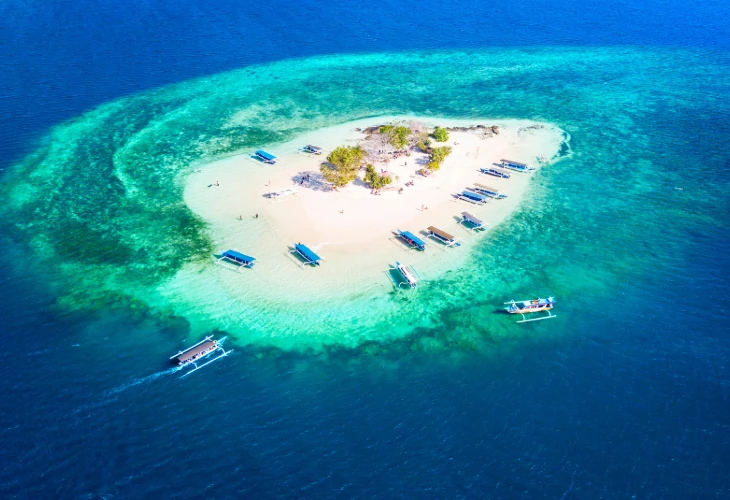
Just a two-hour ferry ride from Bali, the Gili Islands form a small archipelago of three islands off the coast of Lombok, known for their white sand beaches, turquoise waters, and total absence of motorized vehicles. Getting around is only possible on foot, by bicycle, or by cidomo, a traditional horse-drawn carriage. The result is a sense of calm that's hard to find anywhere else in Southeast Asia.
The three islands each have their own distinct character, making it easy to choose based on your travel style:
- Gili Trawangan is the largest and most touristic, with the best hotel infrastructure, the widest selection of restaurants and dive centers, and the most active nightlife of the three. It's the most popular choice for solo travelers and groups.
- Gili Meno is the smallest and most peaceful, with just a handful of accommodations and restaurants. Its beaches are the most unspoiled in the archipelago and it's the top pick for honeymooners or anyone seeking total disconnection.
- Gili Air strikes a happy medium: quieter than Trawangan but with more amenities than Meno. A well-balanced option for couples and families who want an island atmosphere without sacrificing comfort.
All three islands are ideal for snorkeling and diving. The most sought-after experience is swimming alongside sea turtles — something you can even do from the shore in Gili Trawangan and Gili Meno. If you have time, the three-island snorkel tour is an efficient and highly recommended way to see all of them in a single day.

Yogyakarta: the cultural heart of Java (2–3 days)
After your beach days in the Gilis, the perfect contrast is Yogyakarta — affectionately known as Jogja by locals and considered the epicenter of Javanese culture, art, and history. The city blends a historically rich old town with a thriving food scene and an accessibility that makes it one of the favorite stops for travelers exploring Indonesia.
The two unmissable highlights are just outside the city:
- Borobudur Temple, the largest Buddhist monument in the world and a UNESCO World Heritage Site, is especially breathtaking at sunrise, when the light illuminates the Buddha statues through the mist. Comparable in significance to Angkor Wat or Bagan, a visit here ranks among the most memorable experiences of the entire trip.
- Prambanan Temple, also a UNESCO World Heritage Site, is an imposing 9th-century Hindu temple complex dedicated to the Trimurti (Brahma, Vishnu, and Shiva). The contrast between the two complexes — one Buddhist, one Hindu — reflects the rich religious layering of Java. The classic approach is to visit Borobudur at sunrise and Prambanan at sunset.
Within the city itself, it's worth spending time at the Kraton, the Sultan's Palace, which remains the official residence of the ruler and has been the spiritual and political center of Yogyakarta since the 18th century. Don't miss the gamelan and Javanese dance performances held inside. A ten-minute walk away, Taman Sari (the Water Castle) was the former Sultan's leisure and bathing complex: a labyrinth of pools, tunnels, and gardens that is now one of the most photogenic spots in the city.
To wrap up the day, Malioboro Avenue is the commercial and gastronomic heart of Yogyakarta: street food stalls (angkringan), batik shops, markets, and street musicians fill its sidewalks well into the night.

Mount Bromo: Indonesia's most spectacular active volcano (1–2 days)
From Yogyakarta, the most efficient route is to fly to Surabaya and then make your way to Cemoro Lawang, the village that serves as the base for visiting Mount Bromo. This fully active volcano offers one of the most awe-inspiring landscapes in the entire archipelago: a smoking crater rising from a vast black volcanic sand caldera known as the Sea of Sand.
The recommended experience is to wake up early — between 3 and 4 a.m. — to reach the Penanjakan viewpoint before sunrise. From there, with the sun rising between the neighboring peaks of Semeru and Batok, the visual spectacle is hard to put into words. Afterward, descending to the crater and hiking to its rim to watch the smoke rising from within rounds out an unforgettable day. Keep in mind that temperatures in the hours before sunrise can drop significantly, so bring warm layers.

Komodo National Park: home of the world's largest lizard (2–3 days)
From Surabaya, take an overnight flight to Labuan Bajo on the island of Flores — the gateway to Komodo National Park, a UNESCO Natural World Heritage Site and one of the most extraordinary natural parks on the planet. You can explore it on day trips organized from Labuan Bajo, though two- or three-day cruises on a traditional wooden phinisi boat are the most immersive way to experience the park and allow you to reach less-visited corners.
The undisputed star is the Komodo dragon (Varanus komodoensis), the world's largest lizard, with individuals that can exceed three meters in length. It lives only on a handful of islands in the archipelago, and spotting one in its natural habitat — always accompanied by a local guide — is one of the most striking experiences Indonesia has to offer.
The waters surrounding the islands are home to some of the richest marine ecosystems in the region: manta rays, reef sharks, sea turtles, and an explosion of coral life make this a world-class destination for diving and snorkeling. Don't miss Pink Beach, one of the few pink sand beaches in the world, whose color comes from fragments of red coral mixed with white sand.

Lake Toba and Samosir Island: nature and Batak culture (2 days)
The final leg of the route takes you to northern Sumatra, home to Lake Toba, the world's largest volcanic lake, covering more than 1,700 square kilometers. Formed around 75,000 years ago following the eruption of a supervolcano, its scale is so vast that it's hard to believe it's a lake and not an inland sea. At its center lies Samosir Island, large enough to contain its own smaller lakes within it.
Samosir is home to the Batak culture, one of the oldest and best-preserved in the archipelago, known for its textile crafts (the ulos weaving tradition), wood carving, and distinctive decorated stone tombs. Visiting one of the traditional villages in the island's interior, such as Ambarita or Tomok, offers a glimpse into a way of life completely removed from the usual tourist trail.
Lake Toba is the perfect way to close out the trip: an environment of remarkable natural beauty, unusually cool for Indonesia thanks to its altitude, and a sense of calm that contrasts with the intensity of the destinations that came before it.

How long should you spend in Indonesia?
With 15 days, you'll have enough time to complete this route and come away with a broad and representative picture of the country. If you can extend your stay, use the extra time to explore each destination more thoroughly or venture into islands off the beaten path: Raja Ampat, with the most spectacular underwater scenery on the planet; Flores and its multicolored crater lakes at Kelimutu volcano; or Tana Toraja in Sulawesi, one of the most fascinating and least-known cultures in Asia. Indonesia is a country worth coming back to more than once.