
Ivory Coast surprises those who take the time to get to know it. Atlantic beaches, tropical rainforests designated as UNESCO World Heritage Sites, colonial towns, and monumental architecture that rivals any European capital. If you're planning your trip, this guide covers the top tourist attractions in Ivory Coast that you shouldn't leave out of your itinerary. That said, before you fly, it's worth taking care of the paperwork: check how to get a visa for Ivory Coast well in advance.
The Republic of Ivory Coast holds a strategic position on the Gulf of Guinea, giving it an extraordinarily diverse geography: dense tropical rainforest in the south and west, open savanna in the north, and over 300 miles of coastline along the Atlantic Ocean. This diversity makes the country a destination suited to many types of travelers, from ecotourists to urban culture enthusiasts.
What should you see in Ivory Coast? Below you'll find the must-see attractions, organized to help you plan your stay more effectively:
Language and culture: traveling to a French-speaking country
The official language of Ivory Coast, internationally known as Côte d'Ivoire, is French. This makes it a particularly appealing destination for those looking to practice or improve their French while traveling, away from the European tourist trail and generally at a lower cost than France or Belgium.
Beyond the official language, the country is home to more than 60 ethnic groups with their own languages and traditions. The Akan, Mandé, Gur, and Kru peoples form a cultural mosaic reflected in the music, cuisine, crafts, and local festivals. Visiting Ivory Coast means stepping into a cultural richness that very few African destinations can match.
Nature in Ivory Coast: essential parks and reserves
The country has a network of protected natural areas that ranks among its greatest tourist draws. Three of them stand out above the rest:
Taï National Park is the most significant. Covering more than 1.2 million acres of primary tropical rainforest, it is a UNESCO World Heritage Site and one of the last remaining tracts of untouched humid forest in West Africa. It is home to chimpanzee populations whose behavior has been studied by researchers from around the world for decades. The park also shelters leopards, pygmy hippos, more than 1,300 plant species, and remarkable birdlife.
Comoé National Park, in the northeast of the country, is the largest national park in West Africa and another UNESCO World Heritage Site. Its transitional landscape between rainforest and savanna makes it an exceptional habitat for large mammals such as lions, elephants, buffalo, and crocodiles.
The Mount Nimba Strict Nature Reserve, shared with Guinea and Liberia, completes the trio of UNESCO World Heritage natural sites in the country. Its peaks rise above 5,500 feet and are home to endemic species found nowhere else on Earth.
It's no coincidence that the country's name references ivory: historically, the region was one of the main trading hubs for elephant tusks, and elephants can still be spotted in its nature reserves today.

Yamoussoukro: the political capital of Ivory Coast
Located at the geographic center of the country, Yamoussoukro is the official capital of Ivory Coast, although Abidjan remains the economic hub and most populous city. Yamoussoukro was elevated to capital status in 1983 by President Félix Houphouët-Boigny, who was born there.
The city has a planned urban layout, with wide tree-lined avenues, government buildings, and a scale that stands in sharp contrast to the density of Abidjan. Walking through it gives an unusual sense of calm for a national capital. It offers markets, art galleries, local and international restaurants, and adequate hotel options for travelers.
Basilica of Our Lady of Peace: a one-of-a-kind architectural gem in Africa
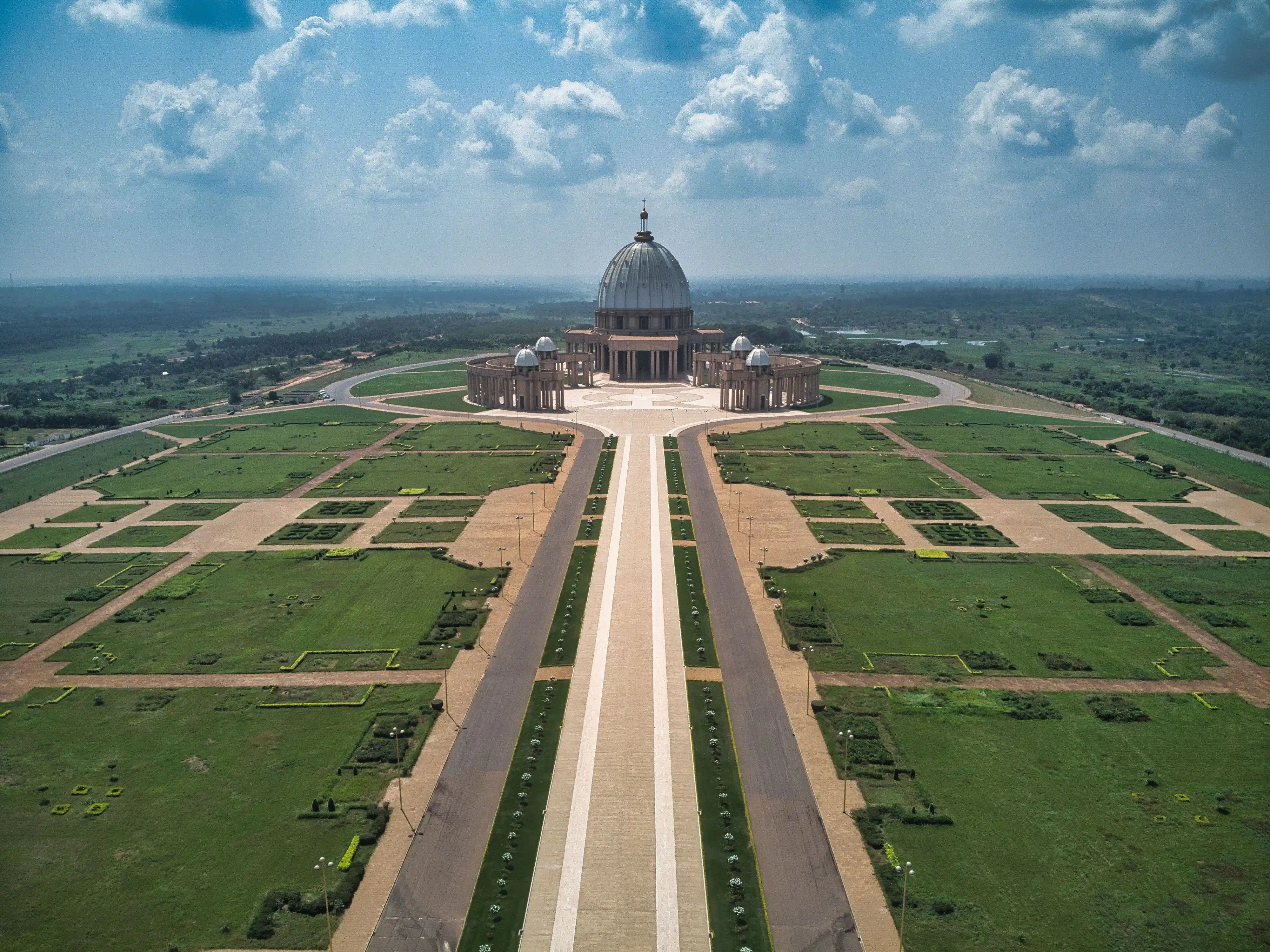
The most visited landmark in Yamoussoukro, and possibly in the entire country, is the Basilica of Our Lady of Peace, known in French as Basilique de Notre-Dame de la Paix. It was built between 1985 and 1989 at the request of President Houphouët-Boigny and inaugurated by Pope John Paul II.
Its main dome rises 518 feet high, surpassing St. Peter's Basilica in the Vatican in height, though not in diameter. It can hold 18,000 people inside and an additional 300,000 on the outdoor esplanade. Its stained glass windows are estimated to contain more leaded glass than all the churches in France combined, making it one of the most ambitious religious architectural achievements of the 20th century.
Since it draws far fewer visitors than its Vatican counterpart, the experience is considerably more peaceful and intimate. Entry to the interior is free, though a special permit is required to access the dome. Plan to spend at least two hours there to truly take it all in.
Abidjan: the modern metropolis of Ivory Coast
Although not the official capital, Abidjan is the economic, cultural, and social heart of the country. With more than five million people in its metropolitan area, it is the largest city in French-speaking West Africa and one of the most dynamic on the continent.
Its business district, Le Plateau, concentrates most of the skyscrapers and offices, and offers panoramic views over Ébrié Lagoon. The Cocody neighborhood is home to embassies, luxury hotels, and one of the most prestigious universities in the region. In contrast, the lively Treichville district is where you get the best feel for the city's daily pulse, with its markets, neighborhood restaurants, and street music.
Abidjan is also the main entry point into Ivory Coast for most international travelers, so it's worth setting aside at least two days in your itinerary.
Grand-Bassam: colonial city and UNESCO World Heritage Site
Just 25 miles east of Abidjan lies Grand-Bassam, the former colonial capital of Ivory Coast and another site on the UNESCO World Heritage List. Its historic center preserves remarkable late 19th- and early 20th-century architecture, with administrative buildings, warehouses, and residences that evoke the French colonial period.
Beyond its historical significance, Grand-Bassam features a long stretch of fine-sand beach along the Atlantic. The combination of architectural heritage and natural surroundings makes it an almost essential day trip from Abidjan.
Traditional cuisine of Ivory Coast
Traveling to Ivory Coast without trying its food would be a real missed opportunity. Ivorian cuisine is built around ingredients like plantains, yam, cassava, rice, and various peanut or tomato-based sauces. Here are some dishes you shouldn't miss:
- Attiéké: fermented cassava semolina, the quintessential side dish found all across the country.
- Kedjenou: a slow-cooked chicken or guinea fowl stew with vegetables and spices, prepared in a sealed clay pot.
- Aloco: fried plantains, often served alongside grilled fish or meat.
- Garba: a popular and affordable street dish made with tuna and attiéké, a staple at food stalls throughout Abidjan.
Local markets and neighborhood restaurants are the best places to try these dishes at reasonable prices and in an authentic setting.
Practical tips before traveling to Ivory Coast
Before planning your trip, keep these key points in mind:
- Visa: most nationalities need a visa to enter the country. Check all the details and steps in our guide on requirements for traveling to Ivory Coast and handle the process ahead of time.
- Vaccinations: the yellow fever vaccine is mandatory. Protection against malaria is also strongly recommended.
- Best time to visit: the dry season, from November to March, is the most advisable time to visit most of the country.
- Currency: the West African CFA franc is the official currency. Credit cards have limited acceptance outside major hotels and shopping centers.
