
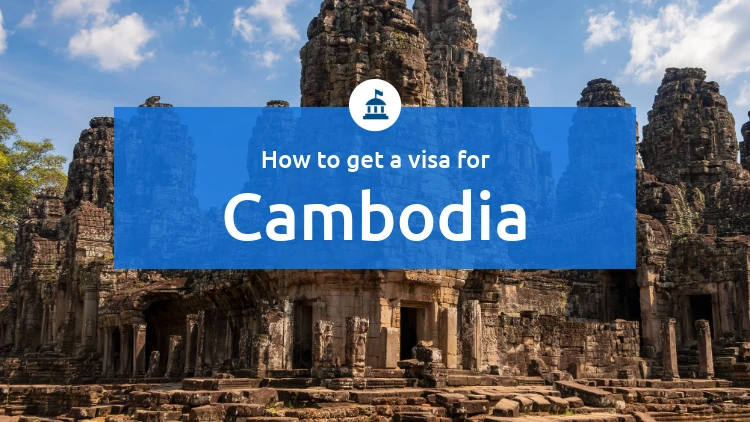
Cambodia is a Southeast Asian country that has regained momentum as a tourist destination in recent years. According to the official tourism statistics report, in 2024 it received around 6.7 million international tourist arrivals, consolidating its position as one of Asia’s most appealing stops for combining culture, history, and nature.
Marked by a complex history, Cambodia now looks to the future through development and tourism. Its greatest icon is the Angkor region (Siem Reap), one of the most important archaeological sites in Southeast Asia: it covers around 400 km² and brings together numerous temples and historic structures, with Angkor Wat as its most recognizable image.
Beyond the temples, Cambodia surprises visitors with its landscapes: the Mekong River, stunning rural areas, and a coastline with peaceful islands and beaches. If you’re planning your trip, below we explain how to obtain the Cambodia visa (eVisa) and what requirements you need to apply, so you can enter the country without any hassles.
Do you need a visa to travel to Cambodia?
In general, yes: to travel to Cambodia for tourism (and also for other purposes), most nationalities need a Cambodia visa. Even so, there is a group of countries with visa exemption for short stays, so it’s worth checking nationality before starting the application.
Citizens of the following countries are visa-exempt for short visits (indicative days according to current agreements): Brunei (14 days), Indonesia (30 days), Laos (30 days), Malaysia (30 days), Myanmar (14 days), the Philippines (30 days), Singapore (30 days), Thailand (normally 14 days) and Vietnam (30 days). In addition, Maldives (30 days) and Seychelles (15 days) also appear in exemption agreements. As these agreements can be updated, it’s best to verify before travel if your case is sensitive (for example, land-border entries or stays close to the limit).
For other travelers, the usual option is to apply for the online visa (Cambodia eVisa) or arrange a visa on arrival when available depending on the border post and nationality.
Some nationalities may not be eligible for the eVisa and, in that case, must apply for a visa at an embassy/consulate or through the route indicated for their passport. Application guides often include a list of non-eligible countries (for example: Afghanistan, Algeria, Saudi Arabia, Bangladesh, Iran, Iraq, Pakistan, Sri Lanka, Sudan, and Nigeria), but since these lists can change, the safest option is to confirm it in the list or with an embassy before traveling.

Types of visas
There are several types of visas to travel to Cambodia depending on the purpose of travel and the way you apply. For short stays, the most common choice is between the online visa (Cambodia eVisa) or the visa on arrival (Visa on Arrival). In addition, there are special categories (for example, diplomats, official guests, or children of Cambodian citizens) that are handled through specific channels.
An important and recent point: to enter Cambodia, the Cambodia e-Arrival system is used, which allows you to complete arrival data and other entry forms electronically. It is recommended to submit it online within the 7 days prior to travel to speed up immigration clearance.
Electronic visa – E-Visa
The Cambodia online visa is requested only online. It is a tourist visa, valid for a 30-day stay from the date of arrival in the country, and it is single entry. The E-Visa can only be used at the following ports of entry:
The online visa for Cambodia (Cambodia eVisa) is requested exclusively online and is the most convenient option if your entry point is enabled. In the official system, there are two main categories: Tourist eVisa (Type T) and Business/Ordinary eVisa (Type E). In both cases, the eVisa is issued as single entry and allows a stay of up to 30 days, with a 3-month validity to enter from the date of issue (according to the official portal’s information).
The eVisa is only valid at authorized ports of entry. Currently, the official portal indicates the following:
By air (airports that accept eVisa)
- Techo International Airport (KTI) (replaces Phnom Penh International Airport as an eVisa entry point from September 9, 2025)
- Siem Reap Angkor International Airport (SAI)
- Sihanoukville International Airport (KOS)
By land (borders that accept eVisa)
- Bavet (Svay Rieng) – border with Vietnam
- Tropaeng Kreal (Stung Treng) – border with Laos
Important notice (update): the official portal indicates temporary closures for entry with eVisa at Cham Yeam (Koh Kong) and Poipet (Banteay Meanchey) “until further notice.” If you plan to enter through a different port (or through a crossing where eVisa entry is temporarily closed), you will not be able to use the eVisa: in that case, you will need to change your entry point to an authorized one or apply through the alternative route that applies (for example, visa on arrival or embassy/consulate, depending on nationality and border post).
If we enter the country through a port of entry different from those mentioned, then we must apply for a Type T tourist visa.

Tourist visa (Type T) – Visa on Arrival
This visa is for travelers going to Cambodia for tourism who are not entering through an eVisa-enabled port, or who simply prefer to apply for the visa on arrival (Visa on Arrival). Note the “T or B” text: for tourism, the standard is the Type T visa; the letter B is not used as “tourism” in the usual traveler classification.
The tourist Visa on Arrival can be requested at international airports (airport operators indicate that the visa is obtained at the visa counter at the 3 international airports: Phnom Penh/Techo, Siem Reap, and Sihanoukville).
At land borders, Cambodia’s official tourism website indicates that you can also obtain a visa at International Check Point border crossings from Thailand, Vietnam, and Laos.
For entry by land or sea, procedures and availability may vary by border post and nationality, so if your route involves a border crossing (for example, a bus from Thailand/Vietnam), it’s best to confirm the exact port of entry and have your documents ready to avoid issues.
Important (update): in addition to the visa (eVisa or visa on arrival), Cambodia requires completing the Cambodia e-Arrival before travel via the official portal or app. The government website states that all travelers must submit the e-Arrival.
By land
Cambodia–Vietnam border (international crossings):
- International checkpoint Bavet (Svay Rieng, Cambodia) / Moc Bai (Tay Ninh, Vietnam)
- International checkpoint Phnom Den (Takeo, Cambodia) / Tinh Bien (An Giang, Vietnam)
- International checkpoint Preak Chak (Kep, Cambodia) / Ha Tien (Kien Giang, Vietnam)
- International checkpoint O’Yadav (Ratanakiri, Cambodia) / Le Thanh (Gia Lai, Vietnam)
- International checkpoint Trapeang Phlong (Kampong Cham/Tbong Khmum, Cambodia) / Xa Mat (Tay Ninh, Vietnam)
- International checkpoint Banteay Chakrei (Kandal, Cambodia) / Dinh Ba (Dong Thap, Vietnam)
- International checkpoint Samrong (Svay Rieng, Cambodia) / Mi Quy Tay (Long An, Vietnam)
- International checkpoint Trapeang Srè (Cambodia) / Bonue (Vietnam)
Cambodia–Thailand border (international crossings):
- International checkpoint Poipet (Banteay Meanchey, Cambodia) / Ban Klong Leuk (Thailand)
- International checkpoint Cham Yeam (Koh Kong, Cambodia) / Hat Lek (Trat, Thailand)
- International checkpoint O’Smach (Oddar Meanchey, Cambodia) / Chong Chom (Surin, Thailand)
- International checkpoint Choam (Oddar Meanchey area, Cambodia) / Chong Sa Ngam (Sisaket, Thailand)
- International checkpoint Prom (Pailin, Cambodia) / Ban Pakard (Chanthaburi, Thailand)
- International checkpoint Dong (Battambang, Cambodia) / Ban Laem (Chanthaburi, Thailand)
Cambodia–Laos border (international crossings)
- International checkpoint Trapeang Kreal (Stung Treng, Cambodia) / Nong Nok Khiene (Laos)
Eligible border points and processing conditions (eVisa or visa on arrival) may change or be temporarily restricted. Therefore, if you plan to enter by land, confirm the exact crossing before traveling and verify that your visa is valid for that port of entry.
By sea
- Port of Sihanoukville
Other visas
The remaining visas listed below must be applied for through the embassy or consulate:
Ordinary / business visa – Type E (Ordinary Visa)
The Type E visa for Cambodia (sometimes called “business/ordinary”) is the most common base for non-tourist travel and for those planning to stay longer. Initially it is usually issued for 30 days, and the key difference compared to the tourist visa is that it allows you to request long-stay extensions depending on the purpose (work/business, job seeking, retirement, or study).
Job-seeking extension – EG (Job-Seeking Extension)
The EG extension is used for job seeking or labor transition cases. It is a common category within the ordinary visa extension scheme.
Retirement visa/extension – ER (Retirement Extension)
The ER category is intended for retired people who want to live in Cambodia for a period without working. It is usually requested by proving retirement status and sufficient financial means.
Student visa/extension – ES (Student Extension)
The ES category is used for studies in Cambodia. It usually requires documentation from the institution (admission/enrollment/letter) and details of the study program.
K visa – for people of Cambodian origin holding a foreign passport
The Type K visa (Khmer/K-Visa) is aimed at people of Cambodian origin traveling with a foreign passport. It is processed with documentary proof of the link/origin (as the embassy indicates) and is a category different from tourism/business.
Diplomatic and official visas – Types A, B, and C
Diplomatic and official visas – Types A, B, and C
- Type A (Diplomatic): for holders of diplomatic passports and diplomatic missions.
- Type B (Official): for official missions (service/official passport, as applicable).
- Type C (Courtesy): for invited guests or courtesy missions with an invitation/formal note.
Transit – D
In practice, if you are only in transit and do not pass immigration (you remain in the international transit area), you usually do not need a visa. If during transit you need to enter the country (for example, leaving the airport or changing terminals with immigration control), it is usually necessary to obtain a visa that allows entry (such as the Type T tourist visa) and confirm the case with the airline or the embassy if you have doubts.

How to apply for a Cambodia visa?
You can apply online, on arrival (on arrival), or at the embassy.
- The e-Visa is processed online. It’s a procedure that won’t take long and you can do it yourself, or outsource it to a third party such as visagov, which will help streamline and ensure the whole process.
- The tourist visa can be obtained upon arrival in the country by air, sea, or land at various border posts.
- The other visas must be obtained in person at an embassy or consulate.
We must be very clear about the purpose of travel and the place of entry, because if we do not obtain the correct visa, it is possible that we may not be able to enter the country.
To travel to Cambodia, you can apply for a Cambodia visa in three ways: online (Cambodia eVisa), on arrival (Visa on Arrival), or through an embassy/consulate (depending on the case and nationality). In addition, before traveling it is advisable to complete the Cambodia e-Arrival, a free online registration recommended/required to speed up entry procedures.
The visa on arrival (Visa on Arrival) still exists for many travelers and can be obtained at international airports and at international border crossings (land) from Thailand, Vietnam, and Laos. If you choose this option, it is recommended to have all documents prepared and allow time for queues during peak season. For long stays or special situations (for example, some official/diplomatic visas or cases not eligible for eVisa), you should apply through the appropriate official channels or consult an embassy/consulate. In any case, it’s crucial that the visa (and its type) matches your purpose of travel and your point of entry, to avoid issues at the border.
Who needs a visa for Cambodia?
In general, most foreign citizens need a visa to enter Cambodia, whether for tourism or other purposes. However, there are visa exemptions for some nationalities (mainly in the ASEAN region) for short stays, so it’s worth checking before applying for an eVisa. According to official tourism information, countries such as Laos, Malaysia, the Philippines, Singapore, Vietnam, Thailand, Indonesia, Brunei Darussalam, and Myanmar are listed as nationalities with visa-free tourist entry for short stays (the duration may vary by agreement). The most practical approach is to confirm the exact details for your passport before traveling.
What requirements are needed to apply for a Cambodia visa?
First, you need to know which type of Cambodia visa you need and check whether your nationality is eligible to apply. You can check here whether your nationality allows you to apply for a Cambodia visa online. If you are eligible to apply for the Cambodia online visa (e-Visa), you will need to meet certain requirements to travel to Cambodia.
To apply for the Cambodia eVisa, you typically need: a passport (recommended with at least 6 months’ validity), a digital passport-style photo, an email address to receive approval, and a card to pay online.
If you obtain the Visa on Arrival upon entry, you will generally be asked for a valid passport (often with 6 months’ validity) and payment of fees in cash depending on the type of visa. In addition, you must complete the Cambodia e-Arrival within the 7 days prior to arrival to speed up the immigration process.

Can the Cambodia visa be modified once processed?
Once an application has been submitted, it’s safest to assume that it cannot be freely “edited” like a form: if you detect an error, you can check the status and, if the system allows it, use the official check/change option to review or request corrections while it is in progress. In any case, fees are usually non-refundable, so it’s important to carefully review your name, passport number, and dates before paying and submitting. If the visa has already been approved with incorrect data, the usual solution is to submit a new application with the correct details or consult the embassy if your case requires another route.
How much does a Cambodia visa cost?
According to the official eVisa portal, the tourist eVisa (Type T) costs USD 30 and the ordinary/business eVisa (Type E) costs USD 35. Both are issued as single entry, with 3 months’ validity to enter and a 1-month stay (30 days). In the case of the Visa on Arrival, fees may be similar, but they can vary by port of entry and visa type; therefore, if you want to avoid changes or surprises, it’s often more convenient to have the eVisa approved in advance.
How far in advance should you apply for a Cambodia visa?
The estimated time to receive an approved online visa is 3 business days for the eVisa. Even so, to travel with enough margin (and in case of reviews or issues), it’s recommended to apply for the Cambodia online visa 1–2 weeks in advance.
The eVisa is valid for 3 months from the date of issue, so it’s best not to apply too early if your trip is far away.
Also remember to complete the Cambodia e-Arrival within the 7 days prior to arrival (it’s free).
What are the entry borders/points into Cambodia?
Cambodia allows entry by air, land, and sea, but not all points accept the eVisa. For air entry, the most common points are the international airports of Phnom Penh (currently operating as Techo International Airport – KTI), Siem Reap Angkor (SAI), and Sihanoukville (KOS).
By land, you can enter from Thailand, Vietnam, and Laos through international border crossings, and by sea there are also international entries (for example, on certain routes). If you travel with an eVisa, confirm that your port of entry accepts eVisa, as the system itself has reported temporary restrictions at some crossings (for example, from Thailand) and these lists can change.
Is a visa required to transit through Cambodia?
If you are only in transit and do not pass through immigration control (you stay in the international transit area), you usually do not need a visa. However, if during the layover you need to enter the country (for example, leaving the airport, collecting luggage and checking in again, or staying overnight outside), then you will need a valid visa (typically a tourist one).
