
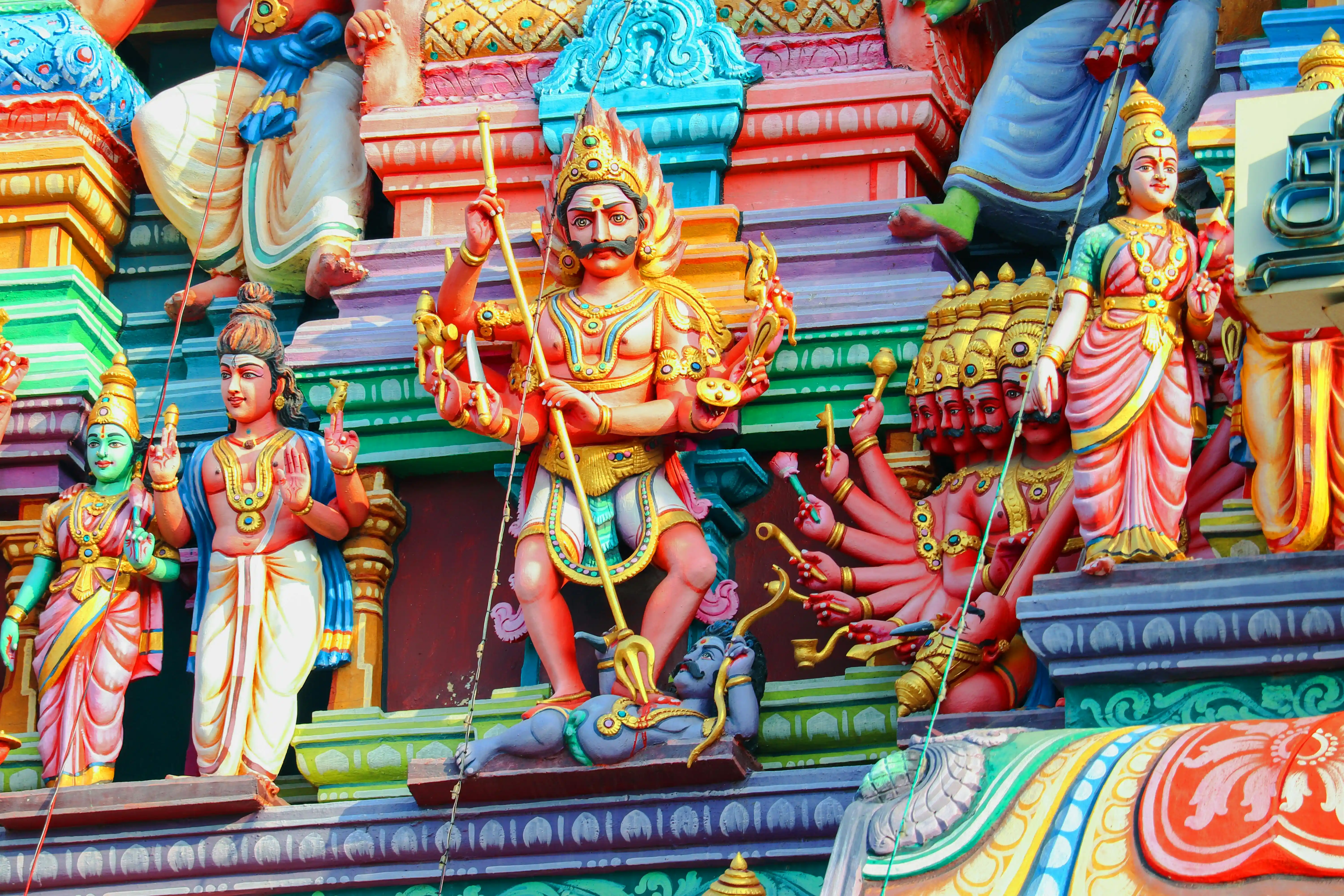
The World Heritage title is the recognition granted by UNESCO to places of outstanding universal value. These sites can be forests, mountains, architectural complexes, or historic cities that are evaluated and confirmed annually by the World Heritage Committee, composed of 21 member states. To learn about the selection criteria, you can consult them on the official program website.
India is one of the countries with the greatest heritage wealth in the world. With 44 sites designated as World Heritage Sites in 2026, 36 cultural, 7 natural, and 1 mixed, it ranks sixth in the world by number of sites recognized by UNESCO. The most recent addition was the Maratha Military Landscapes, inscribed in July 2025 during the 47th session of the World Heritage Committee in Paris.
Below you will find the most outstanding cultural heritage sites in India that you should not miss on your trip to India.
Agra Fort
The Agra Fort, located in the city of Agra (Uttar Pradesh), was inscribed on the World Heritage List in 1983 under criterion III. It is one of the most important Mughal monuments on the Indian subcontinent and one of the first Indian sites to receive this recognition.
Popularly known as the Red Fort of Agra for the red sandstone used in its construction, this 16th-century complex spans 2.5 km of fortified walls and houses some of the most majestic palaces of the Mughal period: the Jahangir Palace and the Khas Mahal, both commissioned by Emperor Shah Jahan. Inside the fort, visitors can also explore the audience halls Diwan-i-Khas and Diwan-i-Am, as well as two remarkably beautiful mosques.
The fort also has a personal connection to Shah Jahan himself: after being deposed by his son Aurangzeb, the emperor spent his final years as a prisoner within these walls, with a view of the Taj Mahal he had commissioned.

Ajanta Caves
The Ajanta Caves, nestled in the state of Maharashtra, were inscribed on the World Heritage List in 1983 under criteria I, II, III, and IV.
This ensemble of 30 rock-cut caves houses some of the oldest and best-preserved Buddhist monuments in the world, dating from the 2nd century BC to the 5th century AD. The murals and sculptures adorning their interiors are considered masterpieces of Buddhist art and have had a profound influence on artistic development throughout Asia.
The best time to visit Ajanta is between October and March, when the heat is more manageable. The caves are closed on Mondays.

Ellora Caves
The Ellora Caves, also located in the state of Maharashtra, were inscribed on the World Heritage List in 1983 under criteria I, III, and VI.
Unlike Ajanta, Ellora is a multi-religious site: its 34 monasteries and temples carved into the rock, stretching over 2 km, belong to Buddhist, Hindu, and Jain traditions and were built between the 6th and 11th centuries. The complex represents the peaceful coexistence of three major religions within a single space.
Its most impressive work is the Kailasa Temple, a Hindu temple carved entirely from a single monolithic rock, considered one of the greatest achievements in rock-cut architecture in history. Ellora is just 30 km from Aurangabad and can easily be combined with a visit to Ajanta in a single day.
Taj Mahal
The Taj Mahal, located in Agra (Uttar Pradesh), was inscribed on the World Heritage List in 1983 under criterion I. It is undoubtedly India's most iconic monument and one of the most recognizable in the world. Check out our guide on what to see in Agra to plan your visit.
This white marble mausoleum was commissioned by Mughal Emperor Shah Jahan in memory of his wife Mumtaz Mahal, who passed away in 1631. Its construction lasted over 20 years and required the work of more than 20,000 craftsmen from across Asia. The complex spans 17 hectares and includes, in addition to the mausoleum, a mosque, a guesthouse, and expansive Persian-style gardens.
To enjoy it without the crowds, it is recommended to visit the Taj Mahal at sunrise, when the light transforms the white marble into shades of pink and gold.

Group of Monuments at Mahabalipuram
The Group of Monuments at Mahabalipuram, on the Coromandel Coast of the Bay of Bengal (Tamil Nadu), was inscribed on the World Heritage List in 1984 under criteria I, II, III, and VI.
This extraordinary ensemble of rock-cut sanctuaries was created by the kings of the Pallava dynasty between the 7th and 8th centuries. The site is especially known for its chariot-shaped temples (rathas), its rock-cut shrines, the monumental bas-relief known as the "Descent of the Ganges" one of the largest in the world at 27 meters wide and 9 meters tall, and the Shore Temple, one of the oldest stone temples in southern India.

Sun Temple at Konârak
The Sun Temple at Konârak, in the state of Odisha, was inscribed on the World Heritage List in 1984 under criteria I, II, and VI.
Built in the 13th century, this temple is a monumental representation of the chariot of Surya, the sun god in the Hindu tradition. The chariot features 24 ornately carved wheels with symbolic motifs and is drawn by seven colossal horses. Considered one of the most celebrated Brahminic sanctuaries in India, it stands out for the extraordinary richness of its bas-reliefs, including erotic themes it shares with the temples of Khajuraho.
Konârak is about 65 km from Bhubaneswar and can be visited alongside the beaches of Puri in a single day.
Churches and Convents of Goa
The Churches and Convents of Goa, in the state of Goa, were inscribed on the World Heritage List in 1986 under criteria II, IV, and VI.
This group of religious buildings stands as an exceptional testament to Portuguese evangelization in Asia and its influence on the development of the Manueline style, Mannerism, and the Baroque in the Asian continent. The Basilica of Bom Jesus is the most prominent building in the ensemble: it houses the remains of St. Francis Xavier, the Navarrese missionary known as the Apostle of the Indies, whose body has remained remarkably preserved for more than four centuries.
Fatehpur Sikri
Fatehpur Sikri, in the Agra district (Uttar Pradesh), was inscribed on the World Heritage List in 1986 under criteria II, III, and IV.
Commissioned in the mid-16th century by Emperor Akbar, this city served as the capital of the Mughal Empire for approximately 14 years before being abandoned, most likely due to water supply issues. Its name means "city of victory." The complex includes the Jama Masjid mosque, one of the largest in India, the tomb of Sheikh Salim Chishti, and the imposing Buland Darwaza gateway, standing 54 meters tall and considered one of the largest gateways in the world.

Group of Monuments at Hampi
The Group of Monuments at Hampi, in the Bellary district (Karnataka), was inscribed on the World Heritage List in 1986 under criteria I, III, and IV.
Hampi was the capital of the last great Hindu kingdom, ruled by the Vijayanagara dynasty between the 14th and 16th centuries. At its peak, it was one of the largest and wealthiest cities in the world, with a population of over 500,000. Its Dravidian temples and palaces were a major center of pilgrimage and admiration for travelers from around the globe until 1565, when the city was conquered and razed by the Deccan Sultanates. Today, its ruins scattered among a landscape of enormous granite boulders form one of the most unique and photogenic archaeological landscapes in India.
Khajuraho Group of Monuments
The Khajuraho Group of Monuments, in the state of Madhya Pradesh, was inscribed on the World Heritage List in 1986 under criteria I and III.
This extraordinary group of temples, built during the Chandela dynasty between 950 and 1050 AD, comprises three groups of temples belonging to Hinduism and Jainism. What makes them unique within India's cultural heritage is the extraordinary richness and explicit eroticism of their sculptures, which have earned them the nickname "temples of the Kama Sutra." However, only 10% of the sculptures depict erotic themes; the rest portray gods, warriors, dancers, and scenes from daily life in medieval India.
Do You Need a Visa to Visit India's Heritage Sites?
To visit any of these sites, you will need to obtain an India visa in advance. The most convenient option is the India e-Visa, which can be applied for entirely online through Visagov. Check out our guide on how to get an India visa for full details on the process.