
Discover everything you need to know before travelling to Sri Lanka: history, geography, culture, gastronomy and top attractions. If you also need to arrange your visa, you can apply quickly and securely through Visagov before you go.
Sri Lanka flag

The flag of Sri Lanka is known as the Lion Flag. Its main elements are:
- A golden lion holding a sword in its right front paw, representing the Sinhalese people and the sovereignty of the country.
- Four golden Ficus religiosa leaves in each corner of the red background, symbolising Buddhism and its four main virtues.
- A red background with two vertical stripes on the left: green, representing the Tamil population, and orange, representing the Muslim population.
- A yellow border surrounding the entire flag, representing all other ethnic groups living in Sri Lanka.
Geography of Sri Lanka

Sri Lanka is an island nation in the Indian Ocean, covering an area of 65,610 km². It is separated from the Asian continent by the Palk Strait, a body of water approximately 54 km wide that divides it from Tamil Nadu in southern India.
The climate is warm and tropical, and the territory is divided into four ecological regions: lowland rainforests, montane rainforests, dry evergreen forests, and Deccan thorn forests. Rainfall can be heavy during certain times of year, so it is worth checking the best season to visit before planning your trip.
In terms of biodiversity, Sri Lanka stands out globally: 27% of its plant species and 22% of its mammals are endemic. Roughly one third of the territory is covered by vegetation, protected through four biosphere reserves, 26 national parks, over 100 forest reserves, and more than 60 wildlife sanctuaries.
The time zone is Sri Lanka Standard Time (UTC+5:30), one of eleven countries in the world with a half-hour offset from standard time.
Does Sri Lanka belong to India?
No. Sri Lanka is an independent country with its own distinct cultural identity. Although its geographic proximity to India has left a clear historical imprint, most notably the arrival of Buddhism via an Indian monk, Sri Lanka has developed its own language, culture, and political system over the centuries.
What is the capital of Sri Lanka?
Sri Lanka has two capitals: Sri Jayawardenepura Kotte is the legislative capital, while Colombo serves as the executive and judicial capital. Colombo is the country's most important city and an essential stop on any itinerary.

History of Sri Lanka
Sri Lanka's origins date back more than 125,000 years, according to archaeological evidence including stone tools and fossils found at sites such as Pahiyangala, Batadombalena, and Belilena. The island was politically organised into independent kingdoms, the most important being Anuradhapura, Polonnaruwa, and Kandy. A lesser-known fact: Sri Lanka was the first country in Asia to be ruled by a woman, Anula of Anuradhapura, who governed from 47 to 42 BC.
A pivotal moment in Sri Lanka's ancient history was the introduction of Buddhism around 250 BC, brought from India by Mahinda, son of Emperor Ashoka. His sister Sanghamitta brought a cutting of the Bodhi tree under which the Buddha is said to have attained enlightenment, a tree that can still be seen today in the ancient city of Anuradhapura.
The following centuries were shaped by European colonial presence. Portuguese explorer Lourenço de Almeida arrived in 1505, and by 1517 Portugal had established a fort in Colombo. In 1638, the Kingdom of Kandy signed a treaty with the Dutch East India Company to expel the Portuguese, but the Dutch violated the terms and kept the territory. Colombo passed into Dutch hands in 1656.
The British Empire seized control of the coast in 1796, establishing the colony of British Ceylon. In 1815 they occupied Kandy, the last surviving independent monarchy, effectively ending Sri Lanka's sovereignty. British rule lasted 133 years, until 1948.
Nationalist sentiment grew steadily after World War I, leading to the creation of the Ceylon National Congress in 1919. Constitutional reforms in 1931 introduced universal suffrage, and in 1947 dominion status was granted. On 4 February 1948, Sri Lanka officially became independent under a parliamentary democratic system.
The post-independence years were marked by tensions between the Sinhalese majority and the Tamil minority, which escalated into a civil war lasting from 1983 to 2009, claiming between 60,000 and 100,000 lives. In 1978 the country adopted its current name: the Democratic Socialist Republic of Sri Lanka.

Culture and traditions of Sri Lanka
Sri Lanka's culture is shaped primarily by two major ethnic groups: the Sinhalese, who make up approximately three quarters of the population and are historically associated with cities such as Kandy and Anuradhapura, and the Tamil, linked to the Jaffna Peninsula. Around 7.5% of the population is of Muslim origin, a community whose roots trace back to Arab trade in the eighth century.
The predominant religion is Buddhism, practiced by 70.2% of the population, followed by Hinduism (12.6%), Islam (9.7%), and Christianity (7.4%). National holidays reflect this diversity: alongside secular dates such as Independence Day (4 February), the calendar includes multiple Buddhist festivals and the Sinhalese and Tamil New Year (14 April).
What language is spoken in Sri Lanka?
The two official languages are Sinhala and Tamil. Sinhala is the most widely spoken, but Tamil is one of the oldest living languages in the world, with written records dating back to the first century AD. English is also widely used across the country, a legacy of the British colonial period.

Food and gastronomy in Sri Lanka
Sri Lankan cuisine revolves around rice, coconut, aromatic herbs, fish, and seafood. A distinctly local ingredient is Ceylon cinnamon, which has a more delicate and sweeter flavour than the common variety; Sri Lanka accounts for around 90% of its global production. The cuisine also reflects influences from India, the Netherlands, and Indonesia, a result of the island's colonial and commercial history.
Typical dishes include rice and curry, kiribath, roti, kool, pittu, and sambal. Among traditional sweets, the most representative are konda kevum, kokis, kalu dodol, aasmi, and aluwa.

Climate in Sri Lanka
Sri Lanka has a tropical climate with two monsoon seasons. The upside is that when one part of the country experiences heavy rainfall, the rest generally enjoys good weather, making it possible to travel year-round with the right planning.
- To visit the north of the island: March to August.
- To visit the south of Sri Lanka: October to March.
Currency in Sri Lanka
The official currency is the Sri Lankan rupee (LKR), divided into 100 cents. Coins come in denominations of 25 and 50 cents and 1, 2, 5, and 10 rupees; banknotes are available in 10, 20, 50, 100, 200, 500, 1,000, 2,000, and 5,000 rupees.
While tourist-oriented establishments generally accept credit cards, it is advisable to carry cash. ATMs are available in most towns and cities. Exchange rates change frequently, so check the current rate before you travel.

Tourist attractions in Sri Lanka
Sri Lanka offers an extraordinary variety of experiences, from ancient cities and wildlife safaris to pristine beaches and scenic train journeys.
The beaches
As an island nation, Sri Lanka's coastline is one of its greatest draws. Beyond their natural beauty, the beaches offer excellent conditions for snorkelling and diving, with rich marine biodiversity throughout the year.
The Cultural Triangle
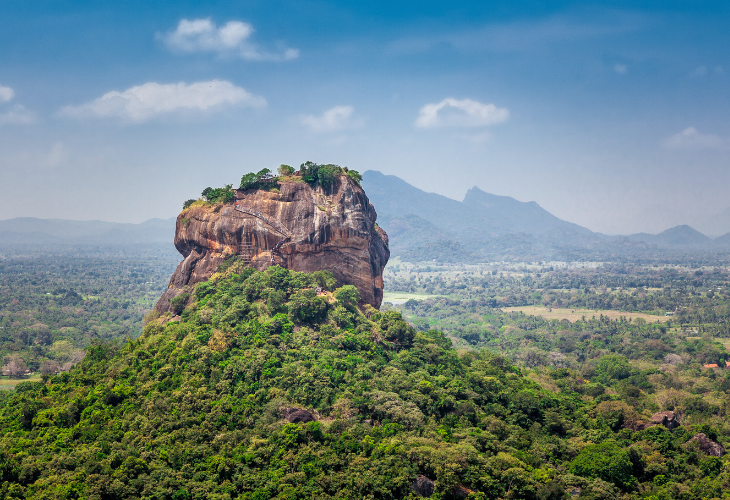
The Cultural Triangle comprises the cities of Anuradhapura, Polonnaruwa, and Kandy, and tours of the area typically include Sigiriya and Dambulla. These cities are home to centuries of history and allow visitors to discover the island's ancient way of life.
Key attractions in Kandy include:
- The Temple of the Sacred Tooth Relic
- The National Museum
- Kandy Lake
In Anuradhapura, highlights include:
- The Ruwanwelisaya stupa
- Jaya Sri Maha Bodhi
- The Thuparama Seya stupa
In Polonnaruwa, the main sights are:
- Gal Vihara temple
- Dalada Maluwa (the Sacred Quadrangle)
- Rankoth Vehera stupa

National parks
Sri Lanka's national parks are one of the best ways to experience the island's natural environment up close. The most visited are Yala and Udawalawe National Parks, where safaris offer the chance to spot elephants, leopards, crocodiles, and hundreds of bird species.
The highlands of Sri Lanka
The central plateau known as the highlands is home to some of the country's most spectacular natural scenery, including Horton Plains National Park and the iconic tea fields. The best way to explore this region is aboard the Kandy to Ella train, widely regarded as one of the most beautiful rail journeys in the world.
Galle
Galle preserves the legacy of its Portuguese and Dutch colonial past. Top sights in the city include:
- Galle Lighthouse
- Dutch Fort
- Japanese Peace Pagoda

Safety in Sri Lanka
Sri Lanka is a safe destination for travellers. That said, it is advisable to avoid protests and political or social demonstrations, which occur periodically due to the country's ongoing economic challenges. As with any popular tourist destination, be alert to pickpocketing on public transport, and keep your original documents in a hotel safe.
When it comes to card payments, scams are relatively common, so it is recommended to pay in cash wherever possible and only use your card when the transaction takes place in your presence.
Do you need a visa to travel to Sri Lanka?
Yes, most foreign travellers need to apply for a Sri Lanka visa before entering the country. The required permit is the eVisa, which is processed entirely online. You will also need a passport valid for at least 6 months and, in some cases, a yellow fever vaccination certificate. You can find all the details in our guide to the entry requirements for Sri Lanka.
If you need to apply for your visa before your trip, you can request it quickly and securely through Visagov, with support available should any issues arise during the process.