
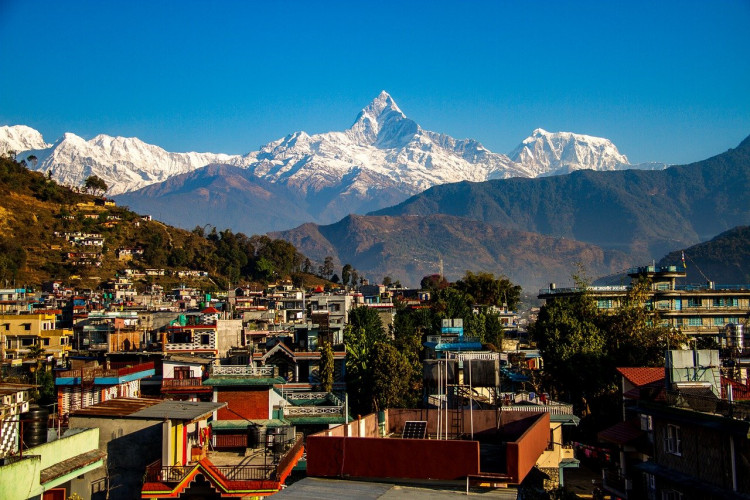
Enclavado entre China e India, Nepal estuvo durante mucho tiempo alejado de los grandes circuitos turísticos. Sin embargo, este fascinante territorio atesora una historia repleta de leyendas míticas: princesas, demonios, brujas y divinidades que se metamorfosean en animales conviven en su imaginario desde hace siglos.
Nepal es mundialmente conocido por sus templos milenarios y sus cumbres himaláyas: el Everest desafía cada año a los alpinistas que sueñan con tocar el cielo. These are the must-see places you can't miss on your trip to Nepal.
Kathmandu
Visiting Nepal without stopping in Kathmandu is simply out of the question. The name of this UNESCO World Heritage city means "wooden temple" in Sanskrit, and the city is indeed dotted with temples, palaces, and pagodas of extraordinary beauty.
Situated at 4,430 feet above sea level, this ancient Newar royal city is a must for history lovers. Don't miss Durbar Square, in front of the old royal palace, where Hindu temples, palaces, and statues abound. The Boudhanath Stupa, with its three great terraces forming a giant mandala, is one of the largest Buddhist stupas in the world.
For a break from the city's hustle and bustle, stroll through the peaceful paths of the Garden of Dreams, an oasis of calm in the heart of Kathmandu.

The Annapurna Massif
Nepal is a world-class destination for trekkers, mountaineers, and hikers of all skill levels. Setting off from the city of Pokhara, the Annapurna Circuit takes you through terraced rice fields, dense forests, mountain villages, and snow-covered trails of breathtaking beauty.
More experienced trekkers can tackle the famous Annapurna Circuit: an 18-day journey through an exceptionally rich ecosystem, ranging from pine forests to towering glaciers. If you're lucky, you might even spot a yak or a snow leopard.
Chitwan National Park
Located southwest of Kathmandu, Chitwan National Park was Nepal's first protected natural area, established in 1973. Its lush plains are home to exceptional wildlife, most notably the famous one-horned rhinoceros and the Bengal tiger.
Recognized as one of Asia's leading examples of biodiversity conservation, Chitwan is best explored with a local guide to maximize your chances of wildlife sightings.

Lumbini, Birthplace of Buddha
Located in the Rupandehi district, just a few miles from the Indian border, Lumbini is the birthplace of Buddha and one of the holiest sites in world Buddhism. A stone marks the exact spot of his birth inside the Maya Devi Temple, dedicated to his mother.
Pilgrims from around the world come to dip their hands in the sacred pond where Maya Devi is said to have bathed before giving birth. In the monastic zone, you'll discover temples built by countries from across the globe to house their Buddhist communities, including the splendid golden pagoda donated by Myanmar. It is in Lumbini where the serenity and spiritual devotion that permeate Nepal are felt most deeply.

Patan, the Ancient Royal City
Patan, also known as Lalitpur ("City of Beauty"), is the ancient royal city of the Kathmandu Valley. It's the ideal destination for exploring Nepal's rich architectural and cultural heritage in a setting far more peaceful than the capital.
Patan is the birthplace of age-old artisan techniques, especially wood carving. Wandering through its narrow streets, you can watch local craftspeople at work and take home a truly unique souvenir. If you want to explore the region at a leisurely pace, Patan makes an excellent base.
Everest and the Base Camp Trek
The world's highest mountain may be out of reach for most travelers, but the Everest Base Camp trek is within reach for motivated hikers in good physical condition. Along the way, you'll encounter mani walls, stupas, and vertiginous suspension bridges.
To reach the starting point of the ascent, you'll fly into Lukla, known for having one of the most spectacular airstrips in the world. The journey will immerse you in Sherpa culture as you pass through villages in the Khumbu region. The most adventurous travelers can follow the ancient route from the village of Jiri, the same path taken by Sir Edmund Hillary and Tenzing Norgay Sherpa during the first ascent of Everest in 1953.

Bardia National Park
Less visited than Chitwan, Bardia National Park is a pristine gem in western Nepal. Once a royal hunting reserve, it is now home to extraordinary biodiversity: 642 animal species and 839 plant species have been recorded within its boundaries.
Despite its remoteness (about 15 hours by road from Kathmandu), Bardia offers truly exceptional wildlife encounters: Bengal tiger, Indian rhinoceros, Asian elephant, and Ganges river dolphin. To observe the animals without disturbing them, we recommend exploring the jungle by canoe, a quiet, environmentally respectful mode of transportation.
The Langtang Valley
The Langtang trek is one of the most beautiful and accessible in Nepal. Running along the Tibetan border, its trails wind through Himalayan forests and bamboo groves, high peaks, alpine meadows, and sweeping glaciers.
The region was severely affected by the 2015 earthquake, but traveler accommodations have been gradually rebuilt. Trekking in Langtang is also a direct way to support the economic recovery of local communities. At a moderate difficulty level, this 8-day trek offers landscapes of impressive variety and beauty. You'll find accommodation in guesthouses and can stop along the way for a warm cup of tea in the sun.
The Pokhara Valley
With its three majestic lakes and sweeping views of the Annapurna range, the Pokhara Valley is one of the most scenic in Nepal. Between Pokhara and Kathmandu, the town of Bandipur is well worth a visit: this remarkably well-preserved town is home to stunning 18th-century traditional Newar houses.
Thrill-seekers can paraglide over the valley, while those with a more contemplative spirit can row across Phewa Lake and soak in a dreamlike landscape. Sarangkot Hill is the perfect spot to watch the sunrise and take in the peaks of the Annapurnas and Machhapuchhre.
Finally, don't miss the Devi's Falls, which plunge nearly 330 feet into a mysterious abyss below. According to legend, two hikers were swept away by its waters, and the waterfall has since carried the name of one of them.