
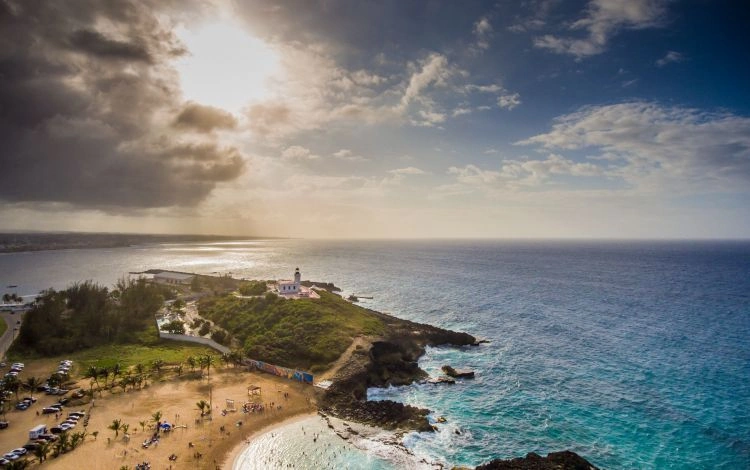
Puerto Rico is one of the Caribbean's true gems: an island full of color, music, and paradisiacal beaches that, uniquely, is a Commonwealth of the United States, meaning that Puerto Rico is part of the United States. If you're planning your trip, this guide covers all the essential information: from geography and history to climate, safety, and entry requirements.
General Information

Before traveling to Puerto Rico, it's helpful to have the basic destination information at hand. Be sure to also review the requirements for traveling to Puerto Rico, as they may be updated and could affect your arrival.
Flag of Puerto Rico

The flag of Puerto Rico consists of five horizontal stripes, three red and two white. On the left side there is a blue triangle with a white star at its center.
It was designed in the late 19th century by Puerto Rican separatists living in New York, specifically by the poet Francisco Gonzalo Marín (Pachín Marín). The red stripes symbolize the blood shed in revolution; the white stripes, the peace that follows independence; the triangle, the sea and the sky; and the white star, the island itself.
It was first raised in 1897. During two periods — Spanish and American rule — displaying it was a criminal offense. It was officially adopted as the flag of the Commonwealth of Puerto Rico in 1952, when the Legislature established new meanings for each of its elements.
Geography of Puerto Rico

Puerto Rico is an archipelago in the Caribbean Sea covering approximately 8,896 km² in area, making it the smallest island of the Greater Antilles. In addition to the main island, its territory includes smaller islands such as Culebra, Vieques, Caja de Muertos, and Mona, as well as numerous cays.
It is located between the Caribbean Sea and the Atlantic Ocean, east of the Dominican Republic and west of the Virgin Islands. More than half of its surface is made up of mountains, though it is also known for its extensive beaches, especially along the southern coast, and a network of over 800 rivers and surface streams. The Río Grande de Arecibo is the island's longest river.
Among its most notable natural spaces is the El Yunque National Forest, the only tropical rainforest in the entire territory of the United States.
History and Heritage of Puerto Rico
Puerto Rico was originally inhabited by the indigenous Taíno people, who lived by farming and had a well-developed social structure. In 1493, Christopher Columbus arrived on the island, marking the beginning of Spanish rule, which would last until the American invasion of 1898 during the Spanish-American War.
In 1900, Puerto Rico was declared a non-incorporated territory of the United States, though the debate over the island's political status continues to this day. Spanish influence is visible in the culture, religion, and architecture; the Afro-Caribbean imprint, in its music and traditions, as a result of the slave trade that persisted until the abolition of slavery in 1873.

Culture and Traditions of Puerto Rico
If there is one thing that defines Puerto Rico, it is its relationship with music. Salsa, plena, and bomba are the island's most representative rhythms. In recent decades, reggaeton has taken Latin America by storm from Puerto Rico, the birthplace of artists such as Daddy Yankee, Bad Bunny, Calle 13, and Ricky Martin.
Each rhythm has its own traditional dances, which reflect the country's diverse and vibrant cultural heritage. Among the most important celebrations are the patron saint festivals, held in many municipalities with music, dancing, parades, and traditional food. Christmas is also celebrated with great enthusiasm, with parrandas and fireworks.
Handicrafts hold an important place in Puerto Rican culture: vejigante masks are worn at festivals, santos de palo are wooden carved figures of saints, and ceramics and woven baskets are popular souvenirs among visitors.
Cuisine of Puerto Rico
Puerto Rican cuisine, known as cocina criolla, reflects the blend of Spanish, African, and indigenous influences. Some of the traditional dishes you shouldn't miss on your trip include:
- Arroz con gandules (rice with pigeon peas)
- Lechón asado (roast pork)
- Mofongo
- Bacalao guisado (stewed salt cod)
- Tostones and amarillos (fried plantains)
- Quesitos (cream cheese pastries)
- Arroz con habichuelas (rice and beans)

Climate of Puerto Rico
The climate of Puerto Rico is tropical and warm year-round, with average temperatures ranging from 21°C to 30°C. The north tends to be slightly cooler than the south.
The heaviest rainfall occurs between May and October. From June to November is hurricane season, making it the least recommended time to travel. From December to March the weather is cooler and drier, coinciding with the high tourist season (along with April and July), when prices also rise. The low season runs from June to November.
Currency of Puerto Rico
As a Commonwealth of the United States, the official currency of Puerto Rico is the US dollar. For information on where to exchange currency, which cards are accepted, travel costs, and tipping, check out our complete guide on currency in Puerto Rico.
Top Tourist Attractions in Puerto Rico
Puerto Rico offers a wide variety of destinations: from historic cities declared UNESCO World Heritage Sites to natural reserves unique in the Caribbean. Below is a selection of must-see places; for a complete guide with full details, visit our article on what to see in Puerto Rico.
Old San Juan
The historic district of the capital is the island's top tourist attraction. Spanning 93 hectares of colorful colonial houses, streets paved with blue cobblestones, and historic squares, Old San Juan is home to landmarks such as Castillo San Felipe del Morro, Castillo San Cristóbal, La Fortaleza, and the Cathedral of San Juan Bautista.

Vieques Island
Located about 10 km southeast of the main island, Vieques is known for its stunning beaches and, above all, Mosquito Bay, considered the brightest bioluminescent bay in the world. It is also a nesting ground for sea turtles.
Culebra Island
Culebra is home to some of the finest beaches in Puerto Rico, with Flamenco Beach leading the way. Its crystal-clear waters are ideal for snorkeling and diving, and the Culebra National Wildlife Refuge lies just offshore.
El Yunque National Forest
The only tropical forest within the United States features 13 trails, waterfalls, natural pools, and extraordinary biodiversity. Bring a raincoat — it is one of the highest-rainfall areas in the entire Caribbean.
Historic Zone of Ponce
Puerto Rico's second-largest city boasts a historic district of great architectural significance, with buildings dating back to the late 19th century. Don't miss the Parque de Bombas firehouse, the Cathedral of Our Lady of Guadalupe, or the Ponce Museum of Art.
Río Camuy Cave Park
This park contains one of the largest cave systems in the Western Hemisphere: 220 caves carved out by the Camuy River, the third-largest underground river in the world.
Rincón
The surfing capital of the Caribbean, Rincón is also one of the island's best spots for watching humpback whales between January and March.
Want to discover more destinations? Explore all the places to visit in our complete guide on what to see and do in Puerto Rico.

Getting Around Puerto Rico
Puerto Rico offers a variety of transportation options: taxis, buses (locally called guaguas), an urban train in the San Juan area, car rentals, and ferries to reach the smaller islands. Renting a car is the most convenient option for exploring the island at your own pace, though it's worth keeping rush-hour traffic in mind near the capital.
For full details on fares, routes, and practical tips, check out our complete guide on getting around Puerto Rico.
Safety in Puerto Rico
Puerto Rico is a safe destination for group travelers, solo travelers, and families, with a crime rate below the United States average. It is also a safe destination for women traveling alone, though basic precautions are always recommended.
The main risks for tourists are pickpocketing and petty theft. Keep your belongings secure and avoid displaying valuables. The safest areas for tourism are San Juan, Rincón, Cabo Rojo, Río Grande, Ponce, Culebra, and Vieques.
As a precaution, it is advisable to avoid areas such as the Caseríos, La Perla, Puerta de Tierra, and Piñones, especially at night. Also check the official travel advisories before you leave, as information may be updated.
Finally, be aware of the risk of hurricanes and earthquakes depending on the time of year you travel. Hurricane season runs from June to November.
Visa for Puerto Rico
Traveling to Puerto Rico requires a valid visa. Certain nationalities can apply for their Puerto Rico visa online, without visiting a consulate in person.
Before planning your trip, make sure you know whether you need a visa to travel to Puerto Rico: it is a mandatory requirement, and applying in advance will help you avoid any last-minute complications.