
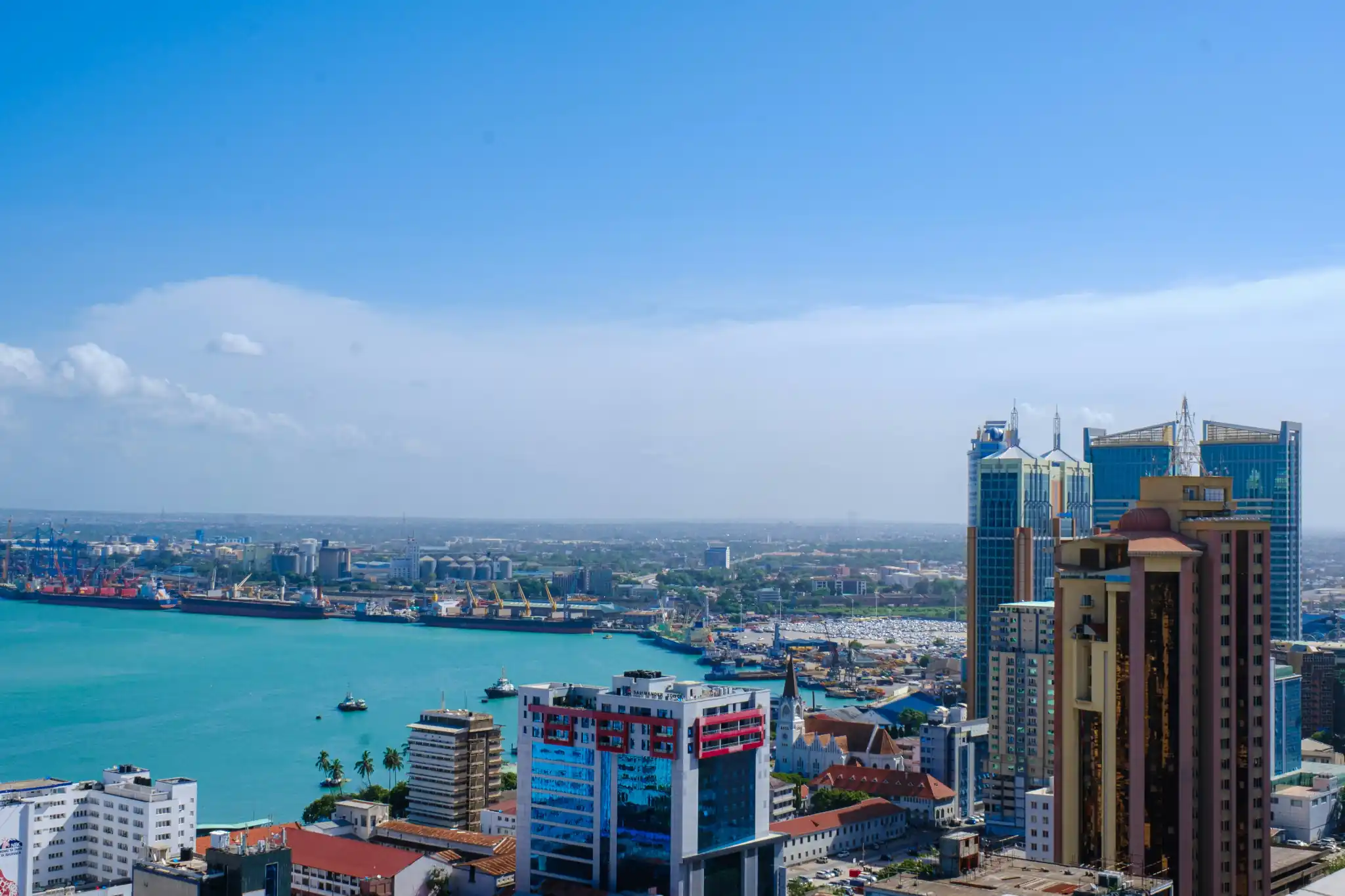
Tanzania is one of the most extraordinary destinations in the world: safaris in the Serengeti, the white sand beaches of Zanzibar, the roof of Africa on Kilimanjaro, and a history that stretches back to the origins of humanity. In this general information guide about Tanzania, you will find everything you need to know before traveling: history, culture, gastronomy, climate, currency, tourist attractions, and much more.
Tanzania flag

The Tanzanian flag was officially established in 1964, when Tanganyika and Zanzibar united to form the United Republic of Tanzania. It is an adaptation of the flag of the Tanganyika African National Union, the driving force behind the country's independence struggle. Each color has a meaning:
- Green: the country's agricultural resources and vegetation
- Black: the people of Tanzania
- Blue: the Indian Ocean that washes the eastern coast
- Yellow: the country's mineral wealth
Where is Tanzania? Map and geography

Tanzania is located in East Africa, with a total area of 945,087 km², making it the thirteenth largest country on the continent. It includes the islands of Zanzibar (Unguja), Pemba, and Mafia. Its population is approximately 70.5 million people (2025 estimate), with a median age of 17.5 years.
Tanzania shares borders with:
- To the north: Uganda and Kenya
- To the south: Zambia, Mozambique, and Malawi
- To the east: the Indian Ocean
- To the west: Rwanda, Burundi, and the Democratic Republic of the Congo
The terrain is predominantly mountainous and includes Mount Kilimanjaro, the highest point in Africa at 19,341 feet (5,895 meters). The country also hosts some of the largest lakes on the continent: Lake Victoria, Lake Tanganyika, and Lake Nyasa, which are part of the world's largest continental rift system.
What is the capital of Tanzania?
Tanzania has two capitals with different functions. Dodoma is the official and legislative capital, with a population of 2.3 million. Dar es Salaam is the commercial capital and the largest and most important city in the country, with 5.7 million inhabitants, and is where the main government buildings and the country's economic activity are concentrated.
History of Tanzania
The history of Tanzania is, in some ways, the history of all humanity. In the Oldupai Gorge (also known as Olduvai), located in the Rift Valley in the north of the country, archaeologists Louis and Mary Leakey found the oldest hominin remains in the world, dating back more than 1.75 million years. Nearby, the Laetoli footprints were also discovered, left by australopithecines approximately 3.6 million years ago — the oldest known footprints of their kind.
The first human communities settled in the region about 10,000 years ago as hunter-gatherers, later joined by large Bantu migrations approximately 2,000 years ago. The Bantu remain the largest community in Tanzania.
During the early centuries of the Common Era, the region traded extensively with the Arab and Persian empires, an exchange that gave rise to the Kiswahili language and the introduction of Islam in Tanzania and Zanzibar. The first European contact came with Vasco da Gama in 1498; Portugal dominated the region until the 18th century, when it was replaced by the Sultanate of Oman. It was during this period that Zanzibar became the most important slave trade hub in the region.
In 1886, an agreement between the British and German Empires divided mainland Tanzania. The part that now constitutes Tanzania was part of the colony of German East Africa, ceded to the British in 1919 under the Treaty of Versailles, which renamed it Tanganyika. Tanzania regained its independence in 1961; Zanzibar followed in 1963, and both united in 1964 to form the United Republic of Tanzania (the name combines "Tan" from Tanganyika and "Zan" from Zanzibar).

Culture and traditions of Tanzania
Tanzanian culture is deeply diverse. The country has more than 120 ethnic groups, mostly of Bantu origin, with the Sukuma being the largest group. Approximately 60% of the population lives in rural areas, where culture remains predominantly agrarian and tribal.
Religion is divided mainly between Christianity (predominant in the interior) and Sunni Islam (especially along the coast and in Zanzibar, where it is the majority religion, particularly in the capital Stone Town). Both coexist alongside traditional folk beliefs.
If your trip coincides with any of these events, you will experience Tanzanian culture in a particularly authentic way:
- Union Day (April 6): celebrates the union of Tanganyika and Zanzibar in 1964.
- Great Serengeti Migration (April–October): one of the most breathtaking natural spectacles on the planet, with millions of wildebeest, zebras, and gazelles crossing the savanna.
- Kilimanjaro Marathon (February): a sporting event at the foot of Kilimanjaro featuring a walk, cycling race, and marathon.
- Zanzibar International Film Festival (July): the most important film and cultural festival in East Africa.
Electrical outlets in Tanzania are types D and G (230V). Remember to bring an adapter if your country uses a different system.
What language is spoken in Tanzania?
Tanzania has two official languages: Swahili (Kiswahili) and English. Swahili, a blend of Bantu dialects and Arabic, is the lingua franca shared by most Tanzanians and the language promoted in primary education and culture. English is used in higher education and official communications.
In Zanzibar, in addition to Swahili and English, Arabic has a significant cultural presence, the result of centuries of Omani influence. Beyond the official languages, Tanzania is home to more than 120 distinct tribal languages, many of which are still actively used within their respective communities.

Tanzanian cuisine
With around 40% of the population employed in agriculture, Tanzanian cuisine has a strong plant-based foundation, enriched with Arab, Indian, and African influences. The most common ingredients are corn, cassava, rice, bananas, beans, leafy greens, pumpkin, and sweet potatoes, along with beef, chicken, goat, and fish.
The most representative dishes are: Ugali (corn porridge, the country's staple food), Pilau, Biryani, Chapati, Kebab, Kashata, and Bagia. As for drinks, tea and coffee are the most widespread. Craft beers with flavors like honey or banana are a unique experience worth trying.

Climate and best time to visit Tanzania
Tanzania offers unique experiences year-round. Check out our guide on the best time to visit Tanzania to plan your trip according to your interests. In general terms:
- Coast and Zanzibar: humid and tropical climate, with temperatures between 81°F and 95°F (27°C–35°C).
- Central plateau: hot and dry.
- Mountain areas and great lakes: cooler and drier.
- Northeastern and southwestern highlands: varied climates, from temperate to tropical.
There are two rainy seasons: the long one or masika (March–May) and the short one or vuli (November–December). The dry season (June–October) is the coolest and the most popular for safaris and climbing Kilimanjaro.
Tanzania is in the East Africa Time Zone (UTC+3), with no seasonal time change.
Currency of Tanzania: the Tanzanian shilling
The official currency of Tanzania and Zanzibar is the Tanzanian shilling (TZS). Banknotes in circulation are in denominations of 500, 1,000, 2,000, 5,000, and 10,000 TZS. You can check the updated exchange rate before your trip, as it fluctuates frequently.
Some practical tips:
- You can exchange money at banks, ATMs, currency exchange offices, and airports. Banks offer the best exchange rates.
- In cities and tourist areas it is possible to pay by credit card, but this is not widespread throughout the country. Always carry cash.
- US dollars are widely accepted, but only bills issued after 2006.
- In rural areas, USD is usually not accepted and ATMs are not available: make sure to carry enough cash before venturing into these areas.

Tourist attractions in Tanzania
Tanzania offers a variety of experiences that are hard to match anywhere else. From the savanna to the beach, from the mountains to the city, discover the main things to see in Tanzania.
Dodoma, the capital of Tanzania
Tanzania's legislative capital offers visits to the Parliament (Bunge), Nyerere Square, the Gaddafi Mosque, and Jamhuri Stadium. It is a rapidly growing city and a reflection of modern Tanzania.
Serengeti National Park
Serengeti National Park is world-famous for hosting the annual Great Migration of wildebeest, zebras, and gazelles — one of the most breathtaking natural spectacles on the planet. It is the second largest national park in Tanzania and one of the most important safari destinations in Africa.
Mount Kilimanjaro
The highest peak in Africa at 19,341 feet (5,895 meters) attracts thousands of hikers from around the world every year. There are multiple ascent routes for different skill levels; the best time to climb is from June to October. If you prefer not to trek, the view of Kilimanjaro from the plains is equally breathtaking.
Ngorongoro Conservation Area
Declared a UNESCO World Heritage Site, the Ngorongoro Crater is a protected area where lions, elephants, rhinos, and extraordinary biodiversity coexist. Its proximity to Oldupai Gorge makes it a must-stop for lovers of history and nature.
Zanzibar: beaches and Stone Town
The Zanzibar archipelago is the perfect destination to round out a safari with a few days on the beach: turquoise waters, white sand, and exceptional marine biodiversity for snorkeling and diving. Stone Town, the capital of Zanzibar and a UNESCO World Heritage Site, offers unique architecture with Arab, European, and African influences that reflects centuries of commercial and cultural history.

Safety in Tanzania
Tanzania is a safe destination for tourists in general, especially in safari areas, national parks, and coastal tourist zones. As with any destination, it is recommended to:
- Avoid displaying valuables or carrying more cash than necessary.
- Avoid walking alone at night, especially in Dar es Salaam.
- Avoid border areas with Mozambique, Burundi, and the Democratic Republic of the Congo.
- Dress modestly in predominantly Muslim areas, especially in Zanzibar outside the beach.
Regarding health, check our guide on vaccines for traveling to Tanzania. There are no mandatory vaccines for travelers, except for the yellow fever vaccine if you are coming from an endemic country. Anti-malarial prophylaxis and mosquito bite protection are recommended.
Visa to travel to Tanzania
Most travelers need a mandatory visa to enter Tanzania. You can apply 100% online through Visagov in just a few minutes, with no travel or waiting required. Available in two options:
- Ordinary visa (single entry): up to 90 days of stay.
- Multiple-entry visa: multiple entries over 12 months, with stays of up to 90 days per entry.
Check all the details in our complete guide on the Tanzania visa, including requirements, price, and timelines.
If your trip includes Zanzibar, remember that since October 2024 it is mandatory to purchase the mandatory travel insurance from the Zanzibar Insurance Corporation (ZIC) before arriving on the island.