
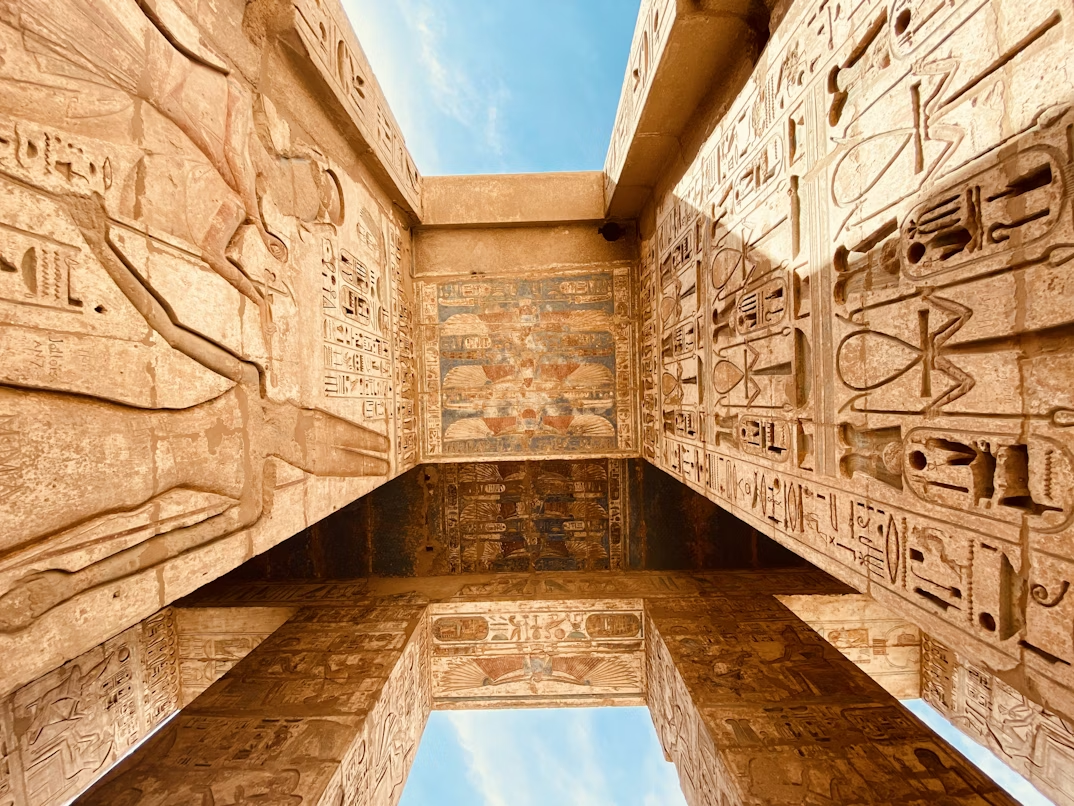
Egypt is one of the most important tourist destinations in the world. The remains of ancient Egypt continue to fascinate travelers from every continent: pyramids, tombs, and temples attract millions of visitors every year. If you are planning a trip to Egypt, here you will find all the general information you need to organize it successfully: from entry requirements to the main tourist attractions, including climate, currency, and safety.
Basic Information About Egypt
| Capital Cairo | Official language Arabic | Currency Egyptian pound (EGP) | Area 1,001,450 km² |
| Population 116+ million | Religion Islam (majority) | Time zone UTC+2 | Electricity 220V / Type C and F |
Before traveling, check the requirements to travel to Egypt, as they may be updated over time.
The Flag of Egypt

The flag of Egypt consists of three horizontal stripes: red, white, and black. It was officially adopted on October 4, 1984. Each color has its own meaning:
- The red stripe represents the period before the 1952 revolution, which culminated in the declaration of the Republic of Egypt.
- The white stripe symbolizes the arrival of the revolution without bloodshed and the end of the monarchy.
- The black stripe represents the end of the oppression of British colonialism.
At the center of the white stripe is the Eagle of Saladin in gold, the national emblem of the country. At its base, the words "Arab Republic of Egypt" can be read in Kufic script.
Map of Egypt

Geography of Egypt
Egypt's neighboring countries are:
- To the east: the Gaza Strip and Palestine.
- To the south: Sudan.
- To the west: Libya.
The southwestern border is shared by Sudan, Libya, and Egypt at a tripoint that coincides with Mount Uweinat, where prehistoric rock engravings can be found in sandstone.
Egypt has nearly 2,500 km of coastline, bordered by the Mediterranean Sea to the north and the Red Sea to the east, connected by the Suez Canal.
The Nile River, the second longest in the world, is fundamental to life in Egypt: it accounts for 10% of the territory suitable for agriculture and human settlement. The remaining 90% is desert. If you take a Nile cruise, you will be able to see the country's most important cities along its banks, from Cairo to Luxor.
Which Continent Is Egypt In?
Egypt's territory, divided into 27 governorates, spans two continents. Although it is mostly located in Africa, the Sinai Peninsula crosses the boundary into Asia, making Egypt a transcontinental country.
History and Heritage of Egypt
More than 5,000 years ago, a civilization settled along the Nile River. Ancient Egypt reached its peak between 1550 and 1069 BC, during the period known as the New Kingdom, ruled by the pharaohs: considered gods in life, the tombs and temples built in their honor are among the most important archaeological treasures in human history.
The Ptolemaic period (332–30 BC) was another crucial era: during this time Cleopatra ruled and the legendary Library of Alexandria was built. In the 7th century AD, the arrival of Islam profoundly transformed the country's culture and religious practice.
In terms of archaeological heritage, Egypt is virtually unmatched worldwide. The Pyramids of Giza, the Great Sphinx, the Valley of the Kings, and the temples of Luxor are just some of the treasures that await the traveler.

Culture and Traditions of Egypt
Egypt's cultural heritage is as remarkable as its architectural one. In ancient Egypt, three writing systems were used: hieroglyphic, hieratic (adapted for papyrus), and demotic (an abbreviated form of hieratic).
The Rosetta Stone, carved in 196 BC and discovered in 1799, was key to deciphering hieroglyphics, as it contains the same text in three scripts: hieroglyphic, demotic, and ancient Greek. It is currently on display at the British Museum in London.
Painting permeated all aspects of Egyptian life: flat colors were used, without perspective, and figures were always depicted in profile.
Religion has always been a central pillar of Egyptian society. Ancient Egypt followed a polytheistic religion; today the country is predominantly Muslim, which is reflected in celebrations such as Eid al-Fitr.
As for music, the Arab tradition holds a central place. The oud (similar to a lute) and the derbake (a drum) are characteristic instruments. Belly dancing is another deeply rooted cultural expression in Egypt.
What Language Is Spoken in Egypt?
The official language of Egypt is Modern Standard Arabic. However, the variety spoken in everyday life is called Egyptian Colloquial Arabic, with its own distinct features that set it apart from Standard Arabic.
Egyptian Cuisine
Egyptian cuisine reflects a confluence of Mediterranean, African, and Middle Eastern influences. The Muslim religion also shapes the diet: pork is absent from traditional cooking.
The most common drinks are Arabic tea (shai) and coffee (ahwa), both part of hospitality customs. Alcoholic beverages are not permitted in religious contexts, though tourists can easily find them at hotels and restaurants.
Some traditional dishes you should not miss:
- Ful Medames: fava beans cooked with olive oil and lemon, the most popular breakfast in the country.
- Kushari: a mix of rice, lentils, pasta, and tomato sauce, considered the national dish.
- Taamiyya: the Egyptian version of falafel, made with fava beans instead of chickpeas.
- Kofta: skewers of spiced ground meat.
- Fattah: bread, rice, and meat in broth, typical of celebrations.
- Baba Ganoush: smoky eggplant dip.
- Molokhiyya: a thick soup made from jute mallow leaves.
Notable desserts include baklava and kunafa, both of Arab heritage and widely enjoyed during festivities.

Climate in Egypt: When to Travel
As a country that is 90% desert, Egypt's climate is hot and dry for most of the year. Check our guide on the best time to travel to Egypt to plan your trip wisely.
- Fall and winter (October–February): temperatures are more pleasant and it is peak tourist season. This is the ideal time to visit Cairo, Luxor, and the archaeological sites.
- Spring (March–May): mild temperatures, although the Sirocco wind can cause sandstorms between March and April.
- Summer (June–September): extreme heat inland, with temperatures that can exceed 122°F. Only recommended for coastal destinations such as Hurghada or Sharm el-Sheikh, where the climate is more moderate (around 86°F).
Currency of Egypt
The official currency of Egypt is the Egyptian pound (EGP), divided into 100 piastres. Banknotes in circulation are in denominations of 1, 5, 10, 20, 50, 100, and 200 pounds; coins come in 5, 10, 25, and 50 piastres and 1 pound.
It is recommended to carry cash, as many establishments, markets, and tourist services do not accept cards. Currency exchange can be done at banks or local exchange offices upon arrival in the country.

Main Tourist Attractions in Egypt
Must-Visit Cities
Cairo
The capital of the country and the gateway to the great monuments of ancient Egypt. In Cairo you will find the Pyramids of Giza, the Great Sphinx, and the Egyptian Museum, one of the most important archaeological museums in the world. Also stroll through the Khan el-Khalili bazaar for the most authentic experience the city has to offer.
Luxor
Considered the world's largest open-air archaeological city, Luxor boasts an unmatched concentration of historic monuments. Do not miss the Luxor Temple, the Karnak complex, the Valley of the Kings, the Valley of the Queens, and the Colossi of Memnon.
Alexandria
Founded by Alexander the Great, Alexandria was for centuries the cultural center of the ancient world. Its most famous legacy is the Library of Alexandria; in 2002, the new Bibliotheca Alexandrina was inaugurated in its honor. Today, the Citadel of Qaitbay is a must-see, built on the site of the ancient Lighthouse of Alexandria, one of the Seven Wonders of the Ancient World.
Aswan
Less crowded than Cairo or Luxor, Aswan offers some of Egypt's most authentic experiences: a felucca ride on the Nile, the Temple of Philae, the Aswan Dam, the Unfinished Obelisk, and above all, the impressive Temple of Abu Simbel, carved into the rock by order of Ramesses II.
Natural Attractions
Beyond its monuments, Egypt offers extraordinary natural scenery. The Red Sea beaches in Hurghada and Sharm el-Sheikh are world-class destinations for scuba diving and snorkeling, thanks to the exceptional biodiversity of the Red Sea coral reef.
The Giftun Islands, near Hurghada, are home to a marine park where dolphins, turtles, barracudas, and manta rays can be spotted. The Sinai region offers a unique mountainous landscape with Mount Sinai as its highlight. And for a truly singular experience, the Siwa Oasis allows you to bathe in natural springs and discover Berber culture.
Must-See Monuments

Pyramids of Giza
The most iconic visit on any trip to Egypt. The Pyramids of Giza, he Great Pyramid of Khufu, the Pyramid of Khafre, and the Pyramid of Menkaure, have stood for over 4,500 years and are the only one of the Seven Wonders of the Ancient World that can still be visited today.
The Karnak Temple
One of the largest temple complexes in the ancient world, located in Luxor. Its forest of columns and colossal scale make it one of the most awe-inspiring visits in Egypt.
The Valley of the Kings
Hidden in the hills of Luxor are the tombs of the pharaohs of the New Kingdom, decorated with paintings in extraordinary condition. The tomb of Tutankhamun is the most celebrated, discovered intact in 1922 by Howard Carter.
The Luxor Temple
Located on the banks of the Nile, this temple is famous for its avenue of sphinxes, its obelisks, and its impressive colonnade. It is especially recommended to visit at dusk, when the lighting turns it into a one-of-a-kind spectacle.
Safety in Egypt
In general terms, traveling to Egypt is safe for tourists. As with any destination, it is advisable to take some basic precautions:
- Follow the instructions of local authorities and tour guides.
- Do not stray from established tourist routes, especially in desert or border areas.
- Avoid demonstrations and large gatherings.
- Keep your belongings secure and avoid displaying cash, jewelry, or valuable electronic devices.
- Respect religious codes of conduct, especially when visiting mosques and sacred sites.
- Check the updated travel advisories from your country's foreign affairs ministry before traveling.
Do You Need a Visa to Travel to Egypt?
Yes. The vast majority of travelers need a visa to enter Egypt. The only visa-exempt nationalities are Bahrain, Israel, Kuwait, the United Arab Emirates, Lebanon, Oman, and Saudi Arabia.
The most convenient way to obtain one is through the Egypt eVisa, which can be processed entirely online before your trip. You can check whether your nationality is eligible for the eVisa using our eligibility checker and, if so, apply for your Egypt visa online through Visagov in just a few minutes.
If you want to know all the details of the process, check out our guide on how to get a visa for Egypt before you travel.